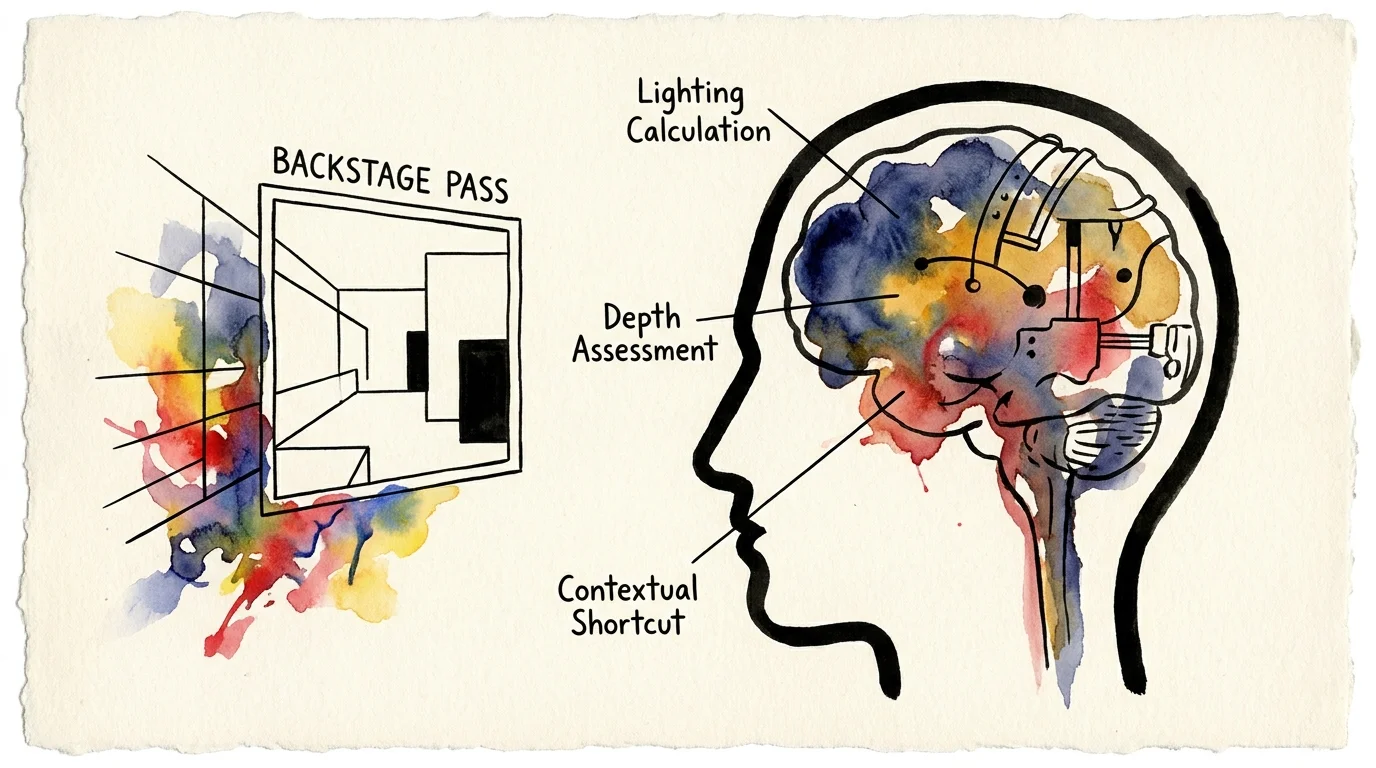
Your visual system constantly edits the world before you even consciously register it, taking shortcuts that drastically shape your reality. When you look at an image, billions of neurons calculate lighting, depth, and context in milliseconds to build a coherent picture. Sometimes, those rapid calculations clash with physical facts, creating a sudden glitch in your perception. These visual glitches expose the unseen machinery operating inside your skull, proving that seeing is rarely just believing. By exploring the science behind these cognitive blind spots, you gain a backstage pass to your own neurology. Let us examine the specific mental tricks that distort colors, bend straight lines, and invent motion where none exists.

Viral Hit #1: The Dress That Divided the Internet
The 2015 viral sensation completely paralyzed social media, dividing friends, families, and celebrities into two fiercely opposed camps. A seemingly mundane photograph of a lace dress forced millions to realize that human vision is entirely subjective. The Dress is one of the most famous optical illusions brain researchers have ever studied because it brilliantly exposes the biological phenomenon of color constancy. Your visual cortex continuously tries to subtract the ambient light source from the objects you look at.
If your brain assumed the dress was heavily shadowed by blue daylight, you saw white and gold; if it assumed a warm artificial light, you saw blue and black. This digital controversy proved just how differently human minds can process the exact same visual data based on subconscious environmental assumptions.
- Origin: A Tumblr post from a Scottish wedding singer in February 2015.
- Scientific Consensus: The physical garment was explicitly confirmed to be blue and black.
- Neurological Trigger: Ambiguous daylight cues cause differing assumptions in the visual cortex.
Viral Hit #2: Adelson’s Checker Shadow Illusion
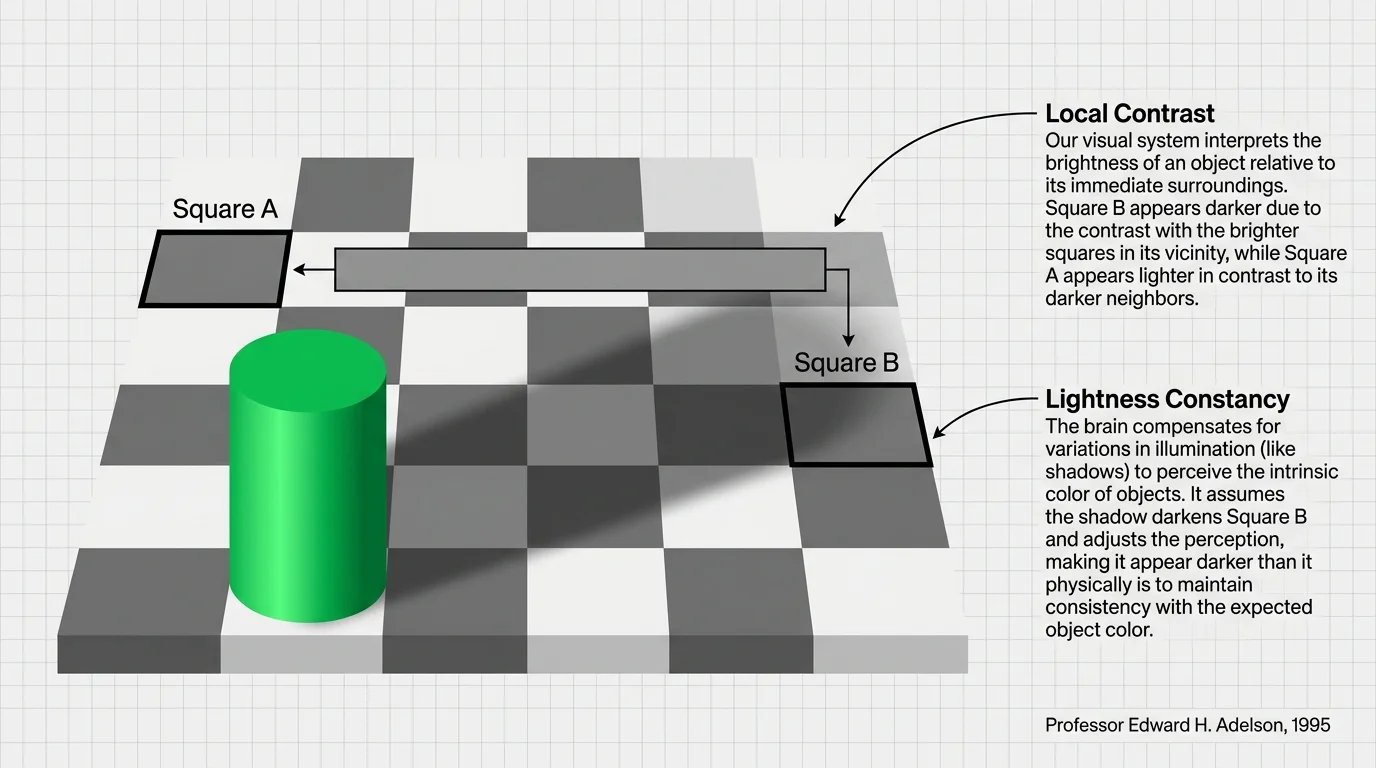
Created by MIT vision scientist Edward Adelson in 1995, the checker shadow trick remains one of the most frustratingly effective cognitive puzzles ever published. The image features a 3D rendering of a checkerboard with a green cylinder casting a soft diagonal shadow. Square A sits in direct light and looks dark gray, while Square B sits in the shadow and looks bright white.
However, if you sample the pixel color of both squares using image software, they share the exact same shade of gray. This demonstrates exactly how brain processes images: by analyzing local contrast rather than measuring absolute light energy. Your mind automatically compensates for the dark shadow, artificially lightening the perceived hue of Square B.
- Core Mechanism: Lightness constancy forces your mind to compensate for environmental shadows.
- Creator: Professor Edward H. Adelson.
- Real-World Application: Helps humans identify objects consistently from high noon to dusk.
Viral Hit #3: The Rotating Snakes Illusion
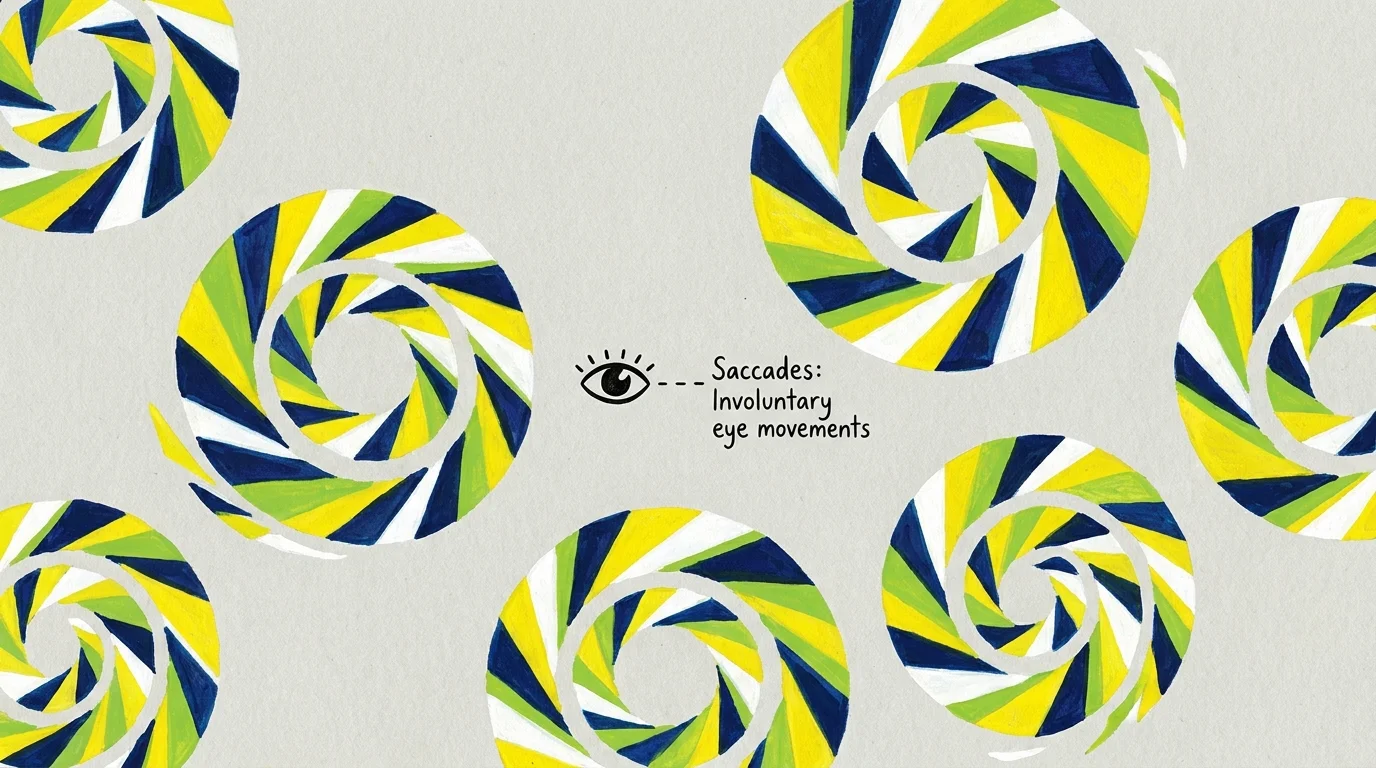
When you glance at Japanese psychology professor Akiyoshi Kitaoka’s vibrant geometric patterns, the coiled circular shapes appear to slither and rotate actively across the screen. Stare intently at one specific point, however, and the movement abruptly freezes. This phenomenon is categorized as a peripheral drift effect, exploiting the tiny, involuntary micro-movements your eyes make—a biological quirk known as saccades.
High-contrast colors placed in specific asymmetrical patterns trick the motion-detecting neurons in your visual pathway into firing continuously. Your visual system struggles to lock down the static image, actively fabricating a sense of kinetic energy where absolutely none exists.
- Visual Catalyst: Asymmetrical high-contrast color steps create false motion signals.
- Biological Quirk: The illusion only happens in your peripheral vision.
- Age Factor: Older individuals often perceive less motion due to naturally slower microsaccade speeds.
Viral Hit #4: The Ames Room
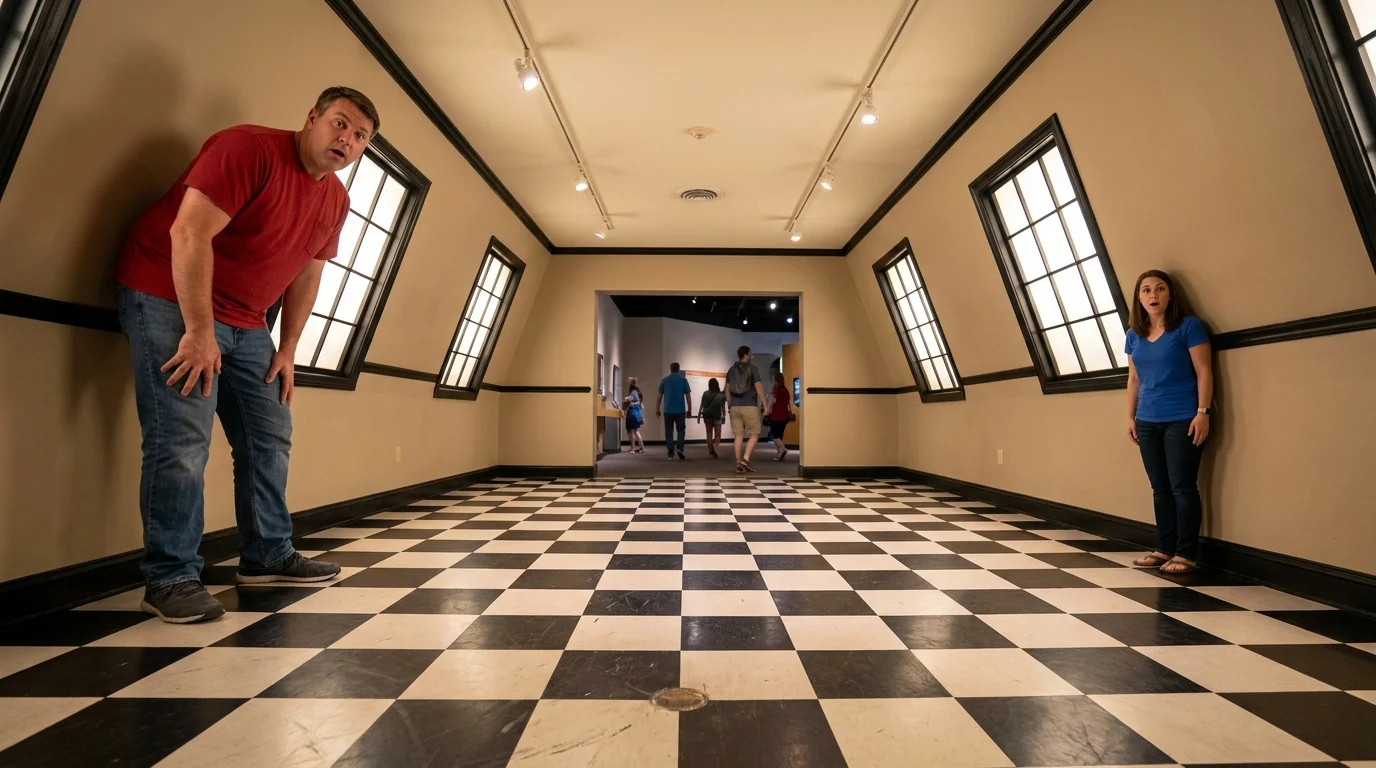
Stepping into an Ames Room feels like walking onto a surreal Hollywood movie set. Viewed through a specific peephole, the room appears completely ordinary and rectangular. Yet, when two people stand in opposite corners, one looks like an imposing giant while the other shrinks to the size of a toddler.
Invented by American ophthalmologist Adelbert Ames Jr. in 1946, this physical construct relies heavily on forced perspective. As far as mind tricks, optical illusions like the Ames Room offer unparalleled insight into our deep reliance on environmental cues. The floor is slanted, the walls are trapezoidal, and the ceiling sharply angles downward; however, your brain heavily distorts the sizes of the people to make the geometry fit a standard box shape.
- Architectural Trick: The true shape of the room is an irregular hexahedron.
- Pop Culture Fame: Filmmakers routinely use similar techniques to adjust actor heights on camera without digital effects.
- Psychological Rule: Size constancy completely fails when depth cues are aggressively manipulated.
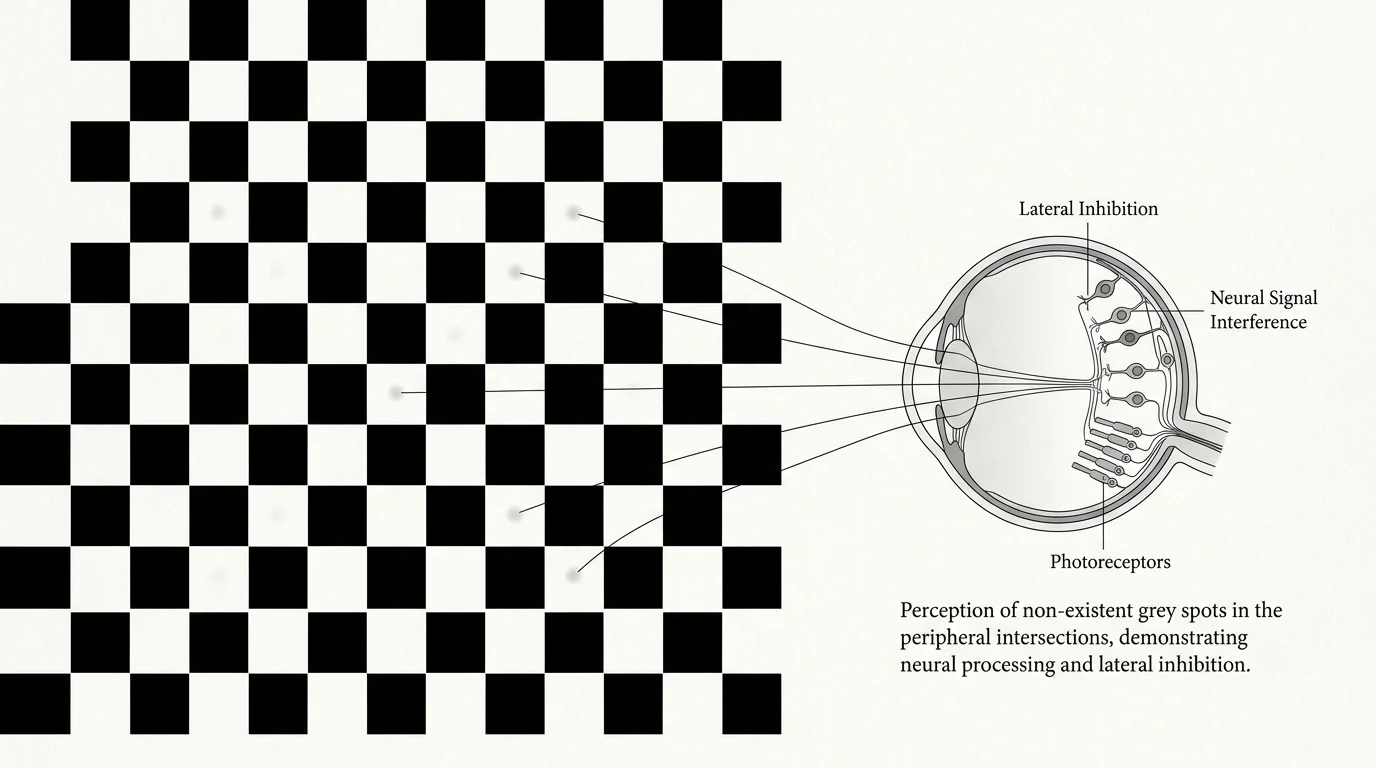
Viral Hit #5: The Hermann Grid
First documented by physiologist Ludimar Hermann in 1870, this classic grid consists of bold black squares separated by stark white lines. As your eyes scan the image, ghostly gray blobs rapidly appear and disappear at the intersections of the white lines. If you try to focus directly on one of these gray smudges, it vanishes instantly.
The reigning scientific theory points to a fascinating biological process called lateral inhibition. The light-sensitive receptors in your retina constantly compete with one another. Highly stimulated receptors suppress the activity of their immediate neighbors, subtly reducing the perceived brightness at the heavily contrasted cross-sections.
- Retinal Mechanism: Retinal ganglion cells calculate local contrast averages on the fly.
- Focal Point Fact: The center of your gaze has smaller receptive fields, removing the illusion when you stare directly at an intersection.
- Design Impact: Frequently affects modern tile flooring and highly contrasted architectural facades.
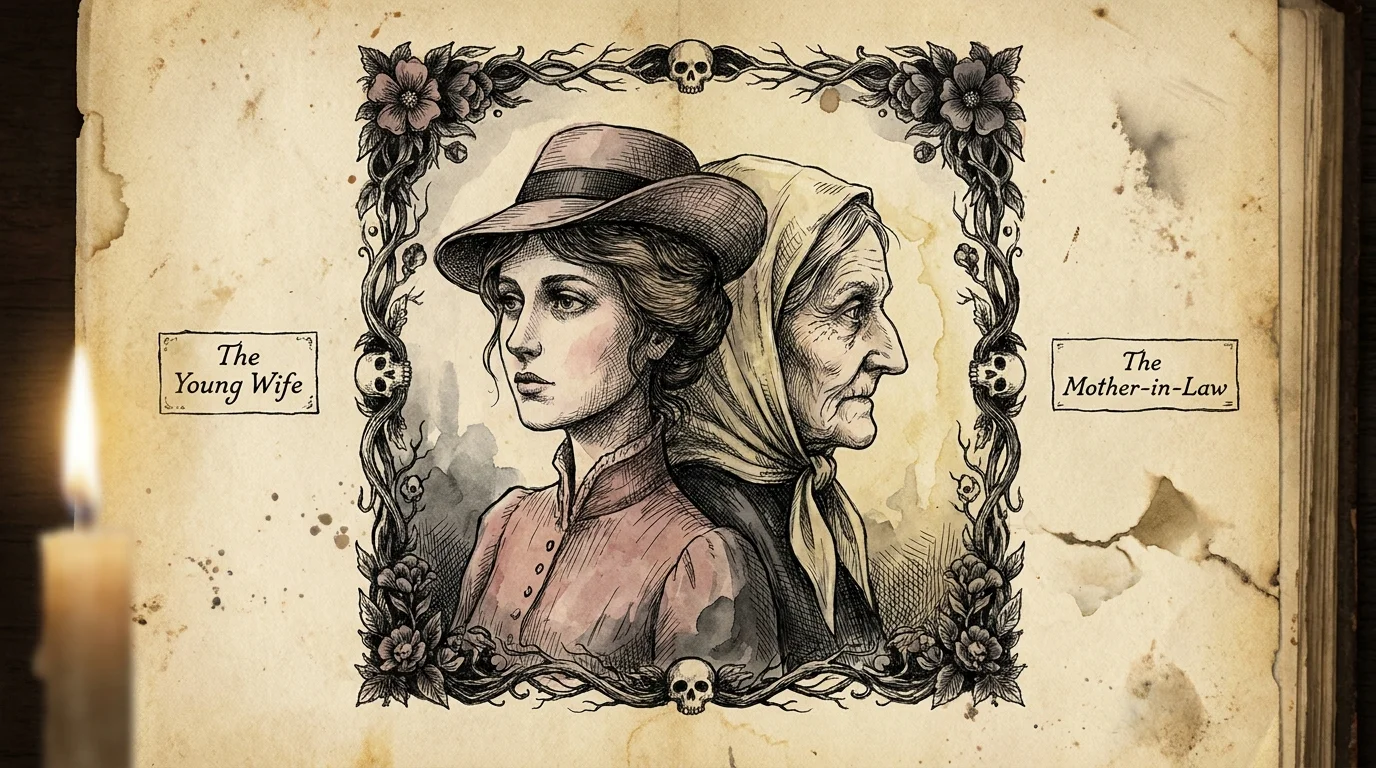
Viral Hit #6: My Wife and My Mother-in-Law
Often cited as the quintessential ambiguous image, this century-old drawing depicts either a young woman turning her face away or an elderly woman staring downward. You can easily see both figures, but your brain physically prevents you from perceiving both simultaneously. This frustrating limitation is formally known as bistable perception.
When looking at this sketch, your visual system rapidly organizes the chaotic black lines into a recognizable face based entirely on your initial point of fixation. If you lock your eyes on the young woman’s delicate chin, it seamlessly doubles as the older woman’s prominent nose, forcing a sudden perspective flip.
- Original Artist: British cartoonist W.E. Hill popularized the sketch in 1915.
- Cognitive Shift: Demonstrates top-down processing, where internal expectations dictate outward reality.
- Age Bias: Studies suggest younger viewers naturally spot the young woman first.
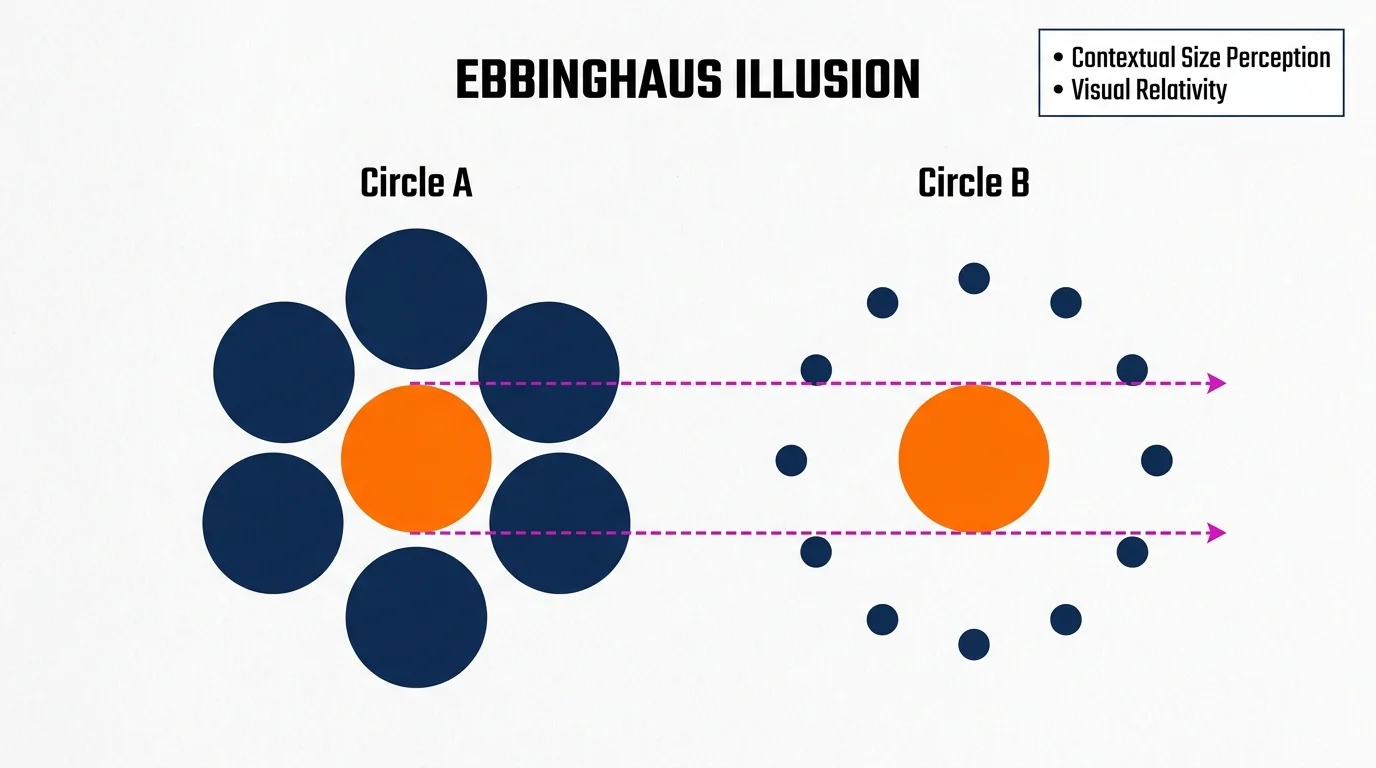
Viral Hit #7: The Ebbinghaus Illusion
Named after German psychologist Hermann Ebbinghaus, this relative size illusion places two identically sized circles side by side. One circle is surrounded by massive shapes, while the exact duplicate is surrounded by tiny dots. Despite being physically equal in diameter, the central circle encased by small dots appears significantly larger.
These brain perception illusions reveal how spatial context drives our automatic size estimation. The visual cortex relies heavily on immediate comparisons to judge scale, borrowing data from adjacent objects rather than taking objective measurements. You rarely perceive true size; you perceive relative proportions.
- Primary Function: Showcases the inherent vulnerability of relative size perception.
- Sports Application: Athletes experience this dynamically; a golf hole looks larger when surrounded by closely mown grass.
- Evolutionary Trait: Helps humans quickly navigate complex environments by evaluating objects against their surroundings.

Viral Hit #8: The Kanizsa Triangle
Imagine three black circles resembling classic arcade game characters, positioned so their open wedge mouths face inward. Immediately, a bright, solid white triangle emerges in the negative space between them. You can clearly see the sharp edges of this phantom shape, even though no physical lines connect the circles.
Italian psychologist Gaetano Kanizsa designed this striking image to highlight the law of closure. When getting visual illusions explained by neuroscientists, you frequently encounter the concept that the human mind inherently despises fragmented information. Your visual cortex literally hallucinates sharp edges to complete the implied shape, prioritizing organization over factual accuracy.
- Illusory Contours: Your brain actively connects the dots to form a cohesive narrative.
- Gestalt Psychology: Proves that the whole is perceived as far greater than the sum of its parts.
- Brightness Shift: The phantom shape often appears demonstrably brighter than the surrounding white background.

Viral Hit #9: The Café Wall Illusion
In this mind-bending geometric pattern, parallel rows of alternating dark and light tiles appear to slope, wedge, and curve erratically. Despite the intense visual distortion making you feel slightly off-balance, the horizontal mortar lines separating the rows are perfectly straight and strictly parallel.
Discovered on the exterior wall of a local café in Bristol, England, by neuropsychologist Richard Gregory, this pattern intentionally wreaks havoc on your local tilt perception. The high-contrast mortar lines and the slightly offset tile placement deeply confuse the orientation-sensitive neurons in the primary visual cortex, forcing your brain to miscalculate the geometry.
- Architectural Origin: Popularized in the 1970s after being spotted on a commercial building in the United Kingdom.
- Neural Confusion: Border-locking mechanisms dramatically fail due to intense contrast gradients.
- Everyday Occurrence: Frequently observed causing unintended dizziness in modern brickwork and digital interface designs.
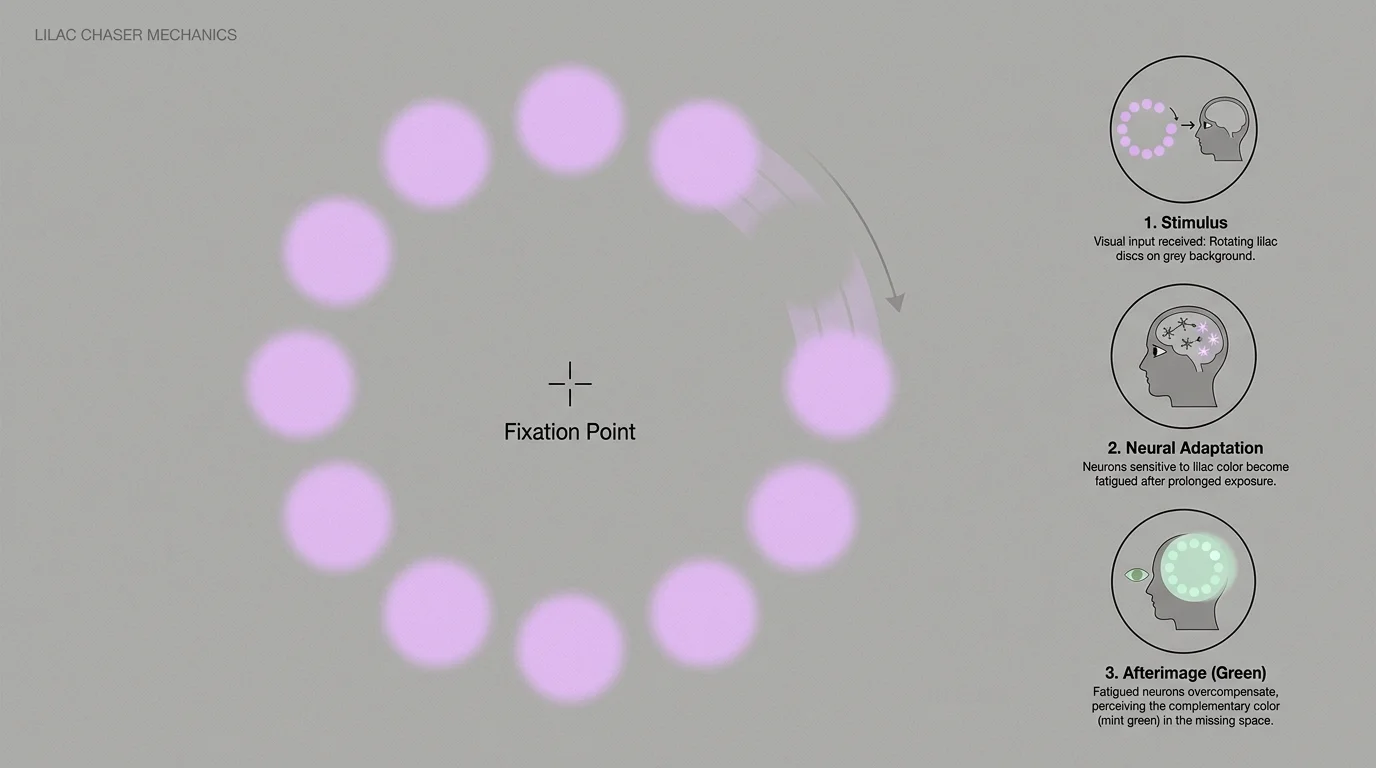
Viral Hit #10: The Lilac Chaser
Staring at a central cross surrounded by a blurry circle of magenta dots unlocks one of the most startling visual hacks available online. Within seconds, a neon green dot begins to run laps around the circle. Keep staring, and the magenta dots will vanish entirely, leaving only the phantom green orb circling an empty white space.
This interactive trick is driven by two specific phenomena: Troxler fading and color aftereffects. The color receptors in your eye quickly exhaust themselves when locked onto the bright magenta hue. In response, they generate a complementary green afterimage to restore visual balance, proving your brain actively paints over exhaustion.
- Troxler’s Fading: Unchanging visual stimuli in peripheral vision rapidly fade from conscious awareness.
- Opponent-Process Theory: Fatigued magenta color receptors prompt the brain to perceive intense green.
- Saccadic Fixation: Any sudden eye movement or blink will instantly reset the illusion.

Keep the Buzz Going: How to Share Responsibly
Optical illusions consistently dominate social media feeds because they prompt immediate, highly visceral reactions. We naturally want to challenge our friends and see if their brains glitch in the exact same way ours did. However, going viral carries an inherent digital responsibility. Before you hit the share button on the next mind-bending image, pause to consider the origin of the artwork and the science behind the trick.
Uncredited artwork hurts independent creators, and mischaracterized science quickly spreads digital clutter. Always attempt to track down the original artist or the academic researcher who published the illusion. Sharing an optical trick is far more rewarding when you provide the underlying context and accurately credit the minds that built it.
For verified reporting and fact-checking, rely on outlets like Reuters and rumor-busting sites such as Snopes. For platform policy updates, follow official resources like the Google Transparency Report.
Sharing accurate, well-sourced information elevates the conversation from a brief moment of internet confusion to a genuine educational experience. When you distribute content responsibly, you help cultivate a smarter digital environment built on robust curiosity and respect.
Frequently Asked Questions
Curiosity surrounding perceptual anomalies often leads to deeper inquiries about human biology and digital rights. Here are detailed answers addressing the most common questions regarding these fascinating visual hacks.
Why do some optical illusions stop working once you know the trick?
Once your brain correctly maps the reality of an obscured or tricky image, it aggressively updates its predictive model. This neurological update shifts your mental processing from a bottom-up approach—building perception from raw data—to a top-down approach that relies on established knowledge. This cognitive shift effectively breaks the illusion, permanently changing how you view the image.
Do people in different regions experience visual tricks differently?
Yes, your environment physically shapes your perception. Cross-cultural psychological studies consistently confirm that people raised in dense, modern cities with right-angled architecture are far more susceptible to sharp geometric illusions. Conversely, individuals living in rural environments or cultures with circular dwellings often process these specific geometric tricks accurately without succumbing to the distortion.
Can creators monetize viral optical illusions?
Digital artists, graphic designers, and scientific researchers can definitely monetize their original designs through digital licensing agreements, physical merchandising, and platform ad revenue shares. However, copyrighting an optical illusion remains incredibly complex, as international copyright law protects specific artistic expressions but firmly excludes the underlying mathematical or scientific principles from ownership.
Are intense optical illusions safe to look at for long periods?
While the vast majority of visual tricks are perfectly harmless, high-contrast, rapidly moving, or flashing patterns can occasionally cause eye strain or mild dizziness. In rare cases, they may trigger photosensitive events in highly susceptible individuals. If a shifting image makes you feel nauseous, simply look away and focus intently on a distant, stationary object to quickly reset your vision.
Disclaimer: Viral stories evolve quickly. Always verify details with primary sources before sharing or acting on this content.






Leave a Reply